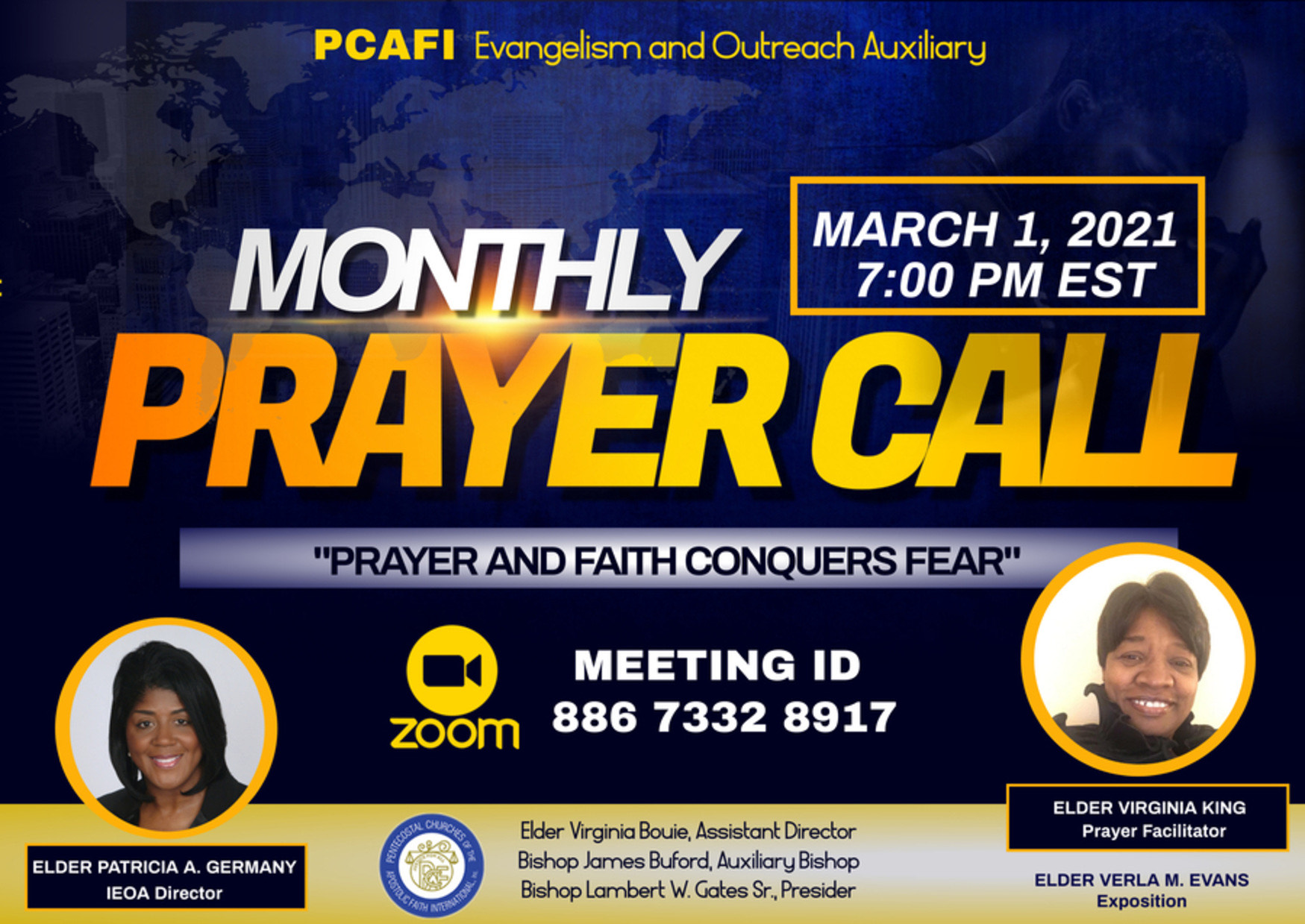
Join the PCAFI – Southwest District Council Tomorrow


SATURDAY, MARCH 18, 2021

Cleave Unto the Lord!
Acts 11:22-28

Zoom Meeting ID: 3363851148
Dial In Phone Number: 312-626-6799

10:00 – 10:15
Opening – Bishop John Jeffrey

10:15 – 11:15
Council Prayer Team
Sis. Breshun Brown – Prayer Lead
Teaching on Prayer
Assist Chair PCAFI Prayer Team

11:25 – 12:15
Youth Department
Sis. Camilla Blue

12:20 – 1:00
LUNCH

1:05 – 1:45
Christian Education Bible Bowl
Pastor James Young

1:50 – 2:50
Bible Class
Bishop John Jeffrey

3:00 – 3:45
Kingsmen – Bro. Timothy Doss
(Closed session for all brothers)

Evening Break

Seek God’s Strength!


ICEA – “Church at Study”

My soul waits in silence for God only;
From Him is my salvation.
He only is my rock and my salvation,
My stronghold; I shall not be greatly shaken.
– Psalm 62:1-2

David was the writer of Psalm 62 above. He was also a great warrior who had strength and ability to lead the nation of Israel. Israel’s army rallied behind him and, together, they won many victories against their enemies. By all accounts the nation trusted him as a victorious and strong leader. Where did David’s strength come from? Reading from (no doubt) David’s writings, it’s safe to say that he SOUGHT God for his continual strength:

Seek the Lord, and his strength: seek his face evermore.
– Psalm 105:4

He wrote from pages in history to tell us what had been his success in leading God’s great nation. It had little to do with his ability to amass chariots or to strategize on a human level, but his directive came from his abiity to SEEK GOD and get His STRENGTH.

From Psalm 62:2, he writes:

“I won’t be greatly moved.”

Using David’s example, we’re talking about getting to a place where we come to trust God’s strength and allow His strength to be infused and channeled through what strength we possess.

As a result of David being victoriously engaged with his opposers (Psalm 62:1-2), it makes sense why he wrote verse 3:

How long will ye imagine mischief against a man?
ye shall be slain all of you: as a bowing wall
shall ye be, and as a tottering fence.

As great and confident as David was, he knew his limitations and taught Israel the reason for his successes (vs. 8):

Trust in him at all times; ye people, pour out your
heart before him: God is a refuge for us. Selah.

The strength that David possessed came from his two-pronged approach to everything that he did. He had the ability to “trust” and “pour out his heart” to God. David also used the word “refuge” in the verse above. Similar biblical words used in scriptures are: high tower, fortress, defense, and stronghold. These words are used as places of security from an enemy. David had built such a relationship with God that he knew SEEKING HIM was next to being strong and “fortress-like.” Only through continually seeking God can we acquire strength and see our foe’s defense as being like bowing walls or weak fences. Throughout this Psalm he speaks similar words (vs. 5-7) because he’s sure God will meet his expectations with STRENGTH and he is even more resolved in his stance not to be overthrown.

As a teacher to Israel, he taught that human strength and resources are frail and don’t last (vs. 9-10):

Surely men of low degree are vanity, and men
of high degree  are a lie: to be laid in the balance,
they are altogether lighter than vanity.
Trust not in oppression, and become not vain in robbery:
if riches increase, set not your heart upon them.

David, the strong but limited warrior, had heard from God (vs. 11) and early in his life he had come to understand that God was the source of his strength:

God hath spoken once; twice have I heard
this; that power belongeth unto God.

Many of us are not warriors in the sense that David was. We are average people with families and lives to lead. Yet, we have been called to engage in everyday battles with real problems that can amount to devastating consequences if we are not strengthened by the things of Christ. It would be our wisdom if we would take frequent times to SEEK THE LORD and HIS STRENGTH, and to SEEK HIS FACE evermore!
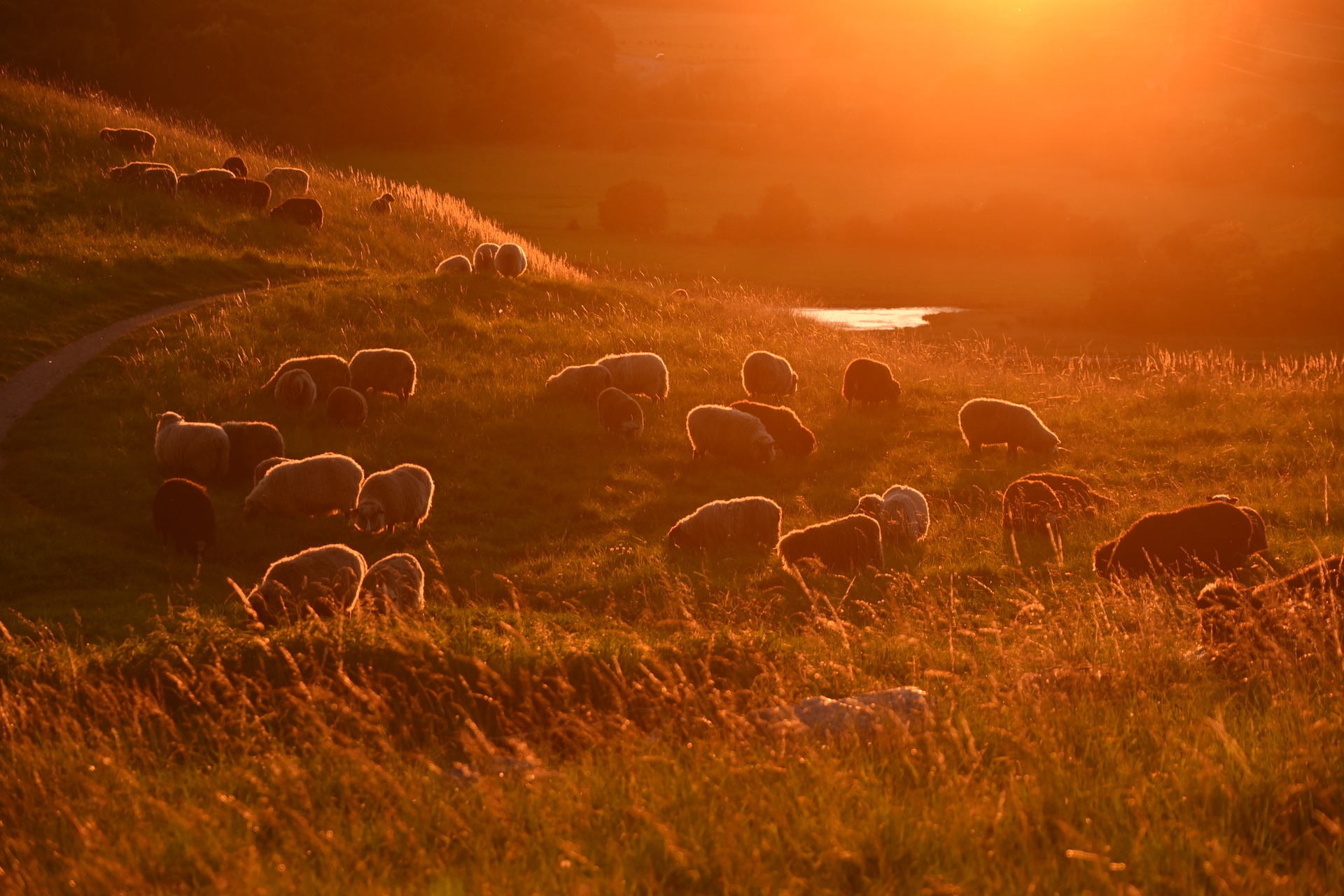
Short Inspiration from the Scriptures: The Lord is My Shepherd…He Is With Me!


sunset-1788272_1920.jpg

David, The Protector of Sheep

David, the writer of Psalms 23, was a man who loved his animals. He cared for them as a good shepherd would and as a result, his animals had no want. David supplied all their needs. When they needed water, he gave them water. When they were sickly, he nurtured them to health. They…at times were afraid; he stayed near. They were in constant dangers from attacks; David diverted their attention while always on watch for their predators. He knew when they were stressed and he would seek out places of rest. He anticipated all of the changing environments and made the necessary adjustments to sustain his helpless creatures.

Identifying with David

In many ways…those of us who are domestic animal lovers and who have cared for animals have a greater appreciation for Psalms 23.  We are constantly concerned about our animals’ welfare — meaning their safety, their health, and what they will eat  (Prov. 12:10).  We spend years building relationships with our pets and understand them on levels that the casual observer would never understand. Real animal lovers can sense the heart of David, the true shepherd, as he met every need of those over his care.

God, The Ultimate Provider

Domestic animal lovers know how helpless their animals are. We go through the daily routines of looking after their needs. We also look upward and understand that God has been doing similar things for us! It is an appreciation we feel toward God, because we understand the relationship we have with our animals. The duty David had with his flock is what caused him to look internally and see the greater relationship God had with him. We see — as David did — the Master provider; the One who oversees our needs and doesn’t fail to mete-out at the appropriate times.

The Lord is my shepherd!
He is with me!

Even When I Walk Through a Very Dark Valley…


“Even though I walk through the darkest valley…”
(Psalm 23:4 – NRSA)

We are familiar with the signs that read, “You are Here”. All of us from time to time have found ourselves in a place where we have stood, wondering how to get from where we were to a better place. Some places have intimidating entrances, looming large as we enter. David, the psalmist, had great experiences with entering dark caves and weathering valleys. (Suddenly, he’s no longer just a character in the Bible, but someone we can identify with.) For years he was chased by king Saul. Those were uncertain years for David. He wrote in I Sam. 20:30 – “There is a step between me and death.” His visibility had diminished to what he could only see close around him. It was like a deep fog that surrounded him and there seemed to be no clearing to any brighter path. It was in that moment that he learned God from the shadows. In this deep darkness he sensed there was no need to be afraid — God was with him! David had great experiences with God, with a lion and a bear, and men similar to Saul.
Somewhere between here and there, the way to our destination is lined with uncertainties, doubts, and things that challenge us to fear. God is with us! He has never taken His eyes off of us — not for one moment. It takes being in a dark place to bring this truth to light. On the other hand, many of us are facing somewhere between here and where the enemy tries to tell us we will wind up being.  He often tries to project our future from where we currently stand. He mockingly tells us, “you are here and this is where you are headed!” Job, no doubt, was faced with similar voices after having lost so much. His response was, “He [God] knows the way I take; when He has tried me I will come forth as gold (Job 23:10). So — there is an intervening period — something that happens in the mean time! It takes place before the outcome of what has been negatively predicted. God is continually in that interim — watching and moving as we travel through the darkness.
We are somewhere between the place we have started and a destination. The forecast can be bleak, but God is familiar with each valley. While we travel, our destination is to see Jesus and to enter into a place of finality. He is the one who has gone on before us and now ever lives to make intercessions for us. Fear not little flock, it is our Father’s pleasure to give us the kingdom!